


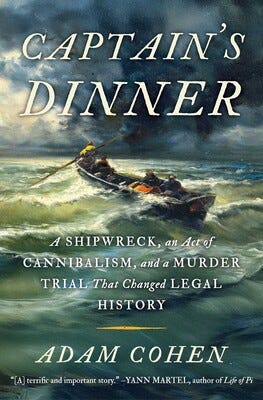
Welcome back to SOURCE NOTES. This week’s subject will appeal to fans of THE WAGER, or THE RIME OF THE ANCIENT MARINER, or THE NARRATIVE OF ARTHUR GORDON PYM OF NANTUCKET. The book is CAPTAIN’S DINNER: A Shipwreck, An Act of Cannibalism, and a Murder Trial That Changed Legal History. (“Four men in a boat and a grisly choice,” as NPR describes it.) The author is Adam Cohen, a lawyer and former New York Times editorial board member who has a Substack of his own with lots of bonus material related to the book. Fair warning: our conversation gets a little stomach-churning at times…
In a previous newsletter I described CAPTAIN’S DINNER as a 19th Century high seas sensation.
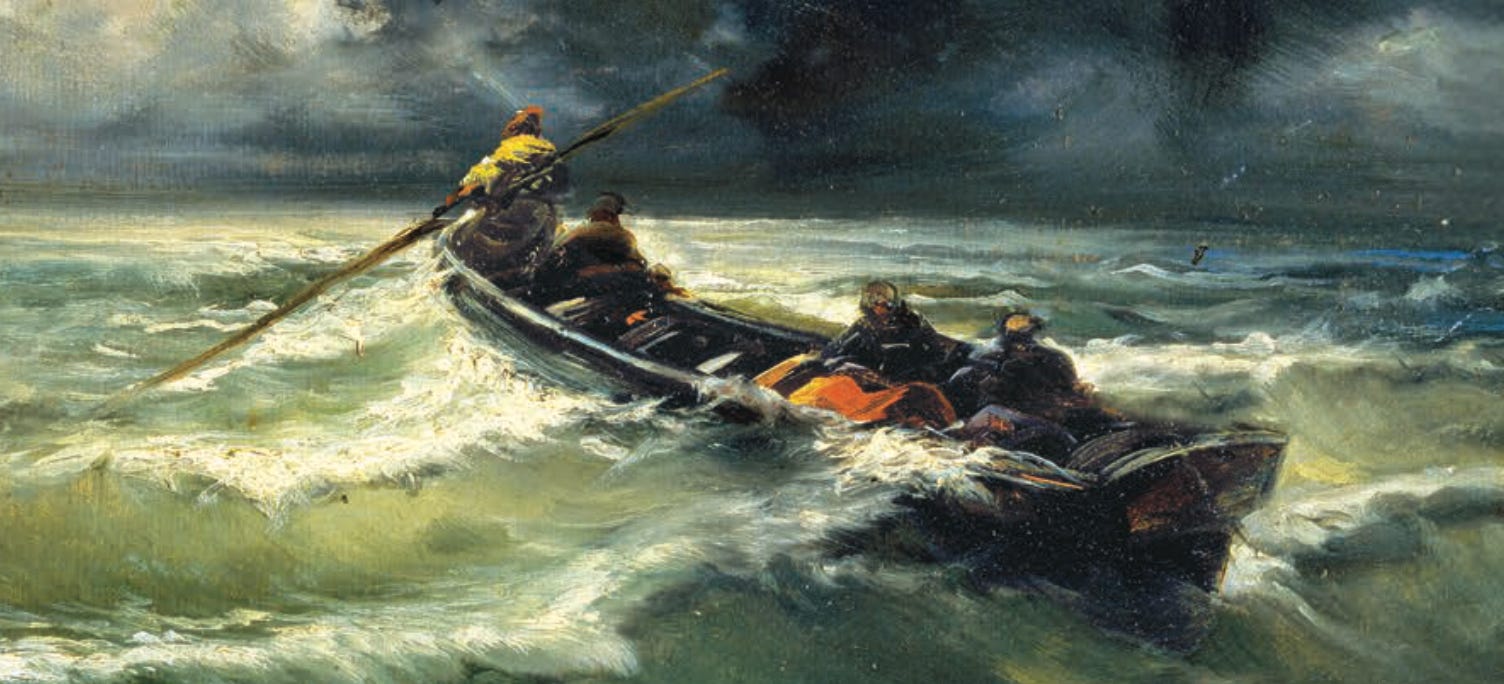
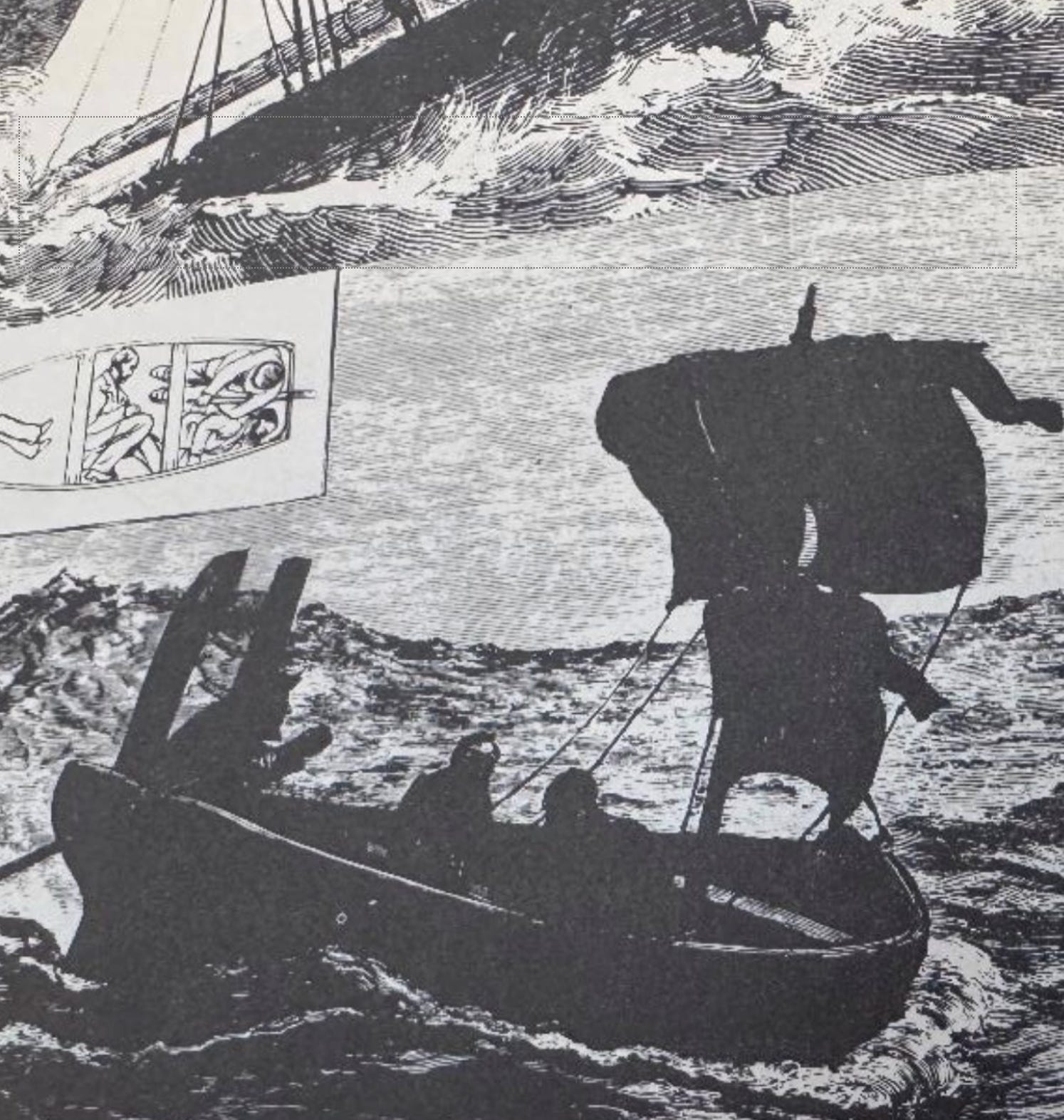
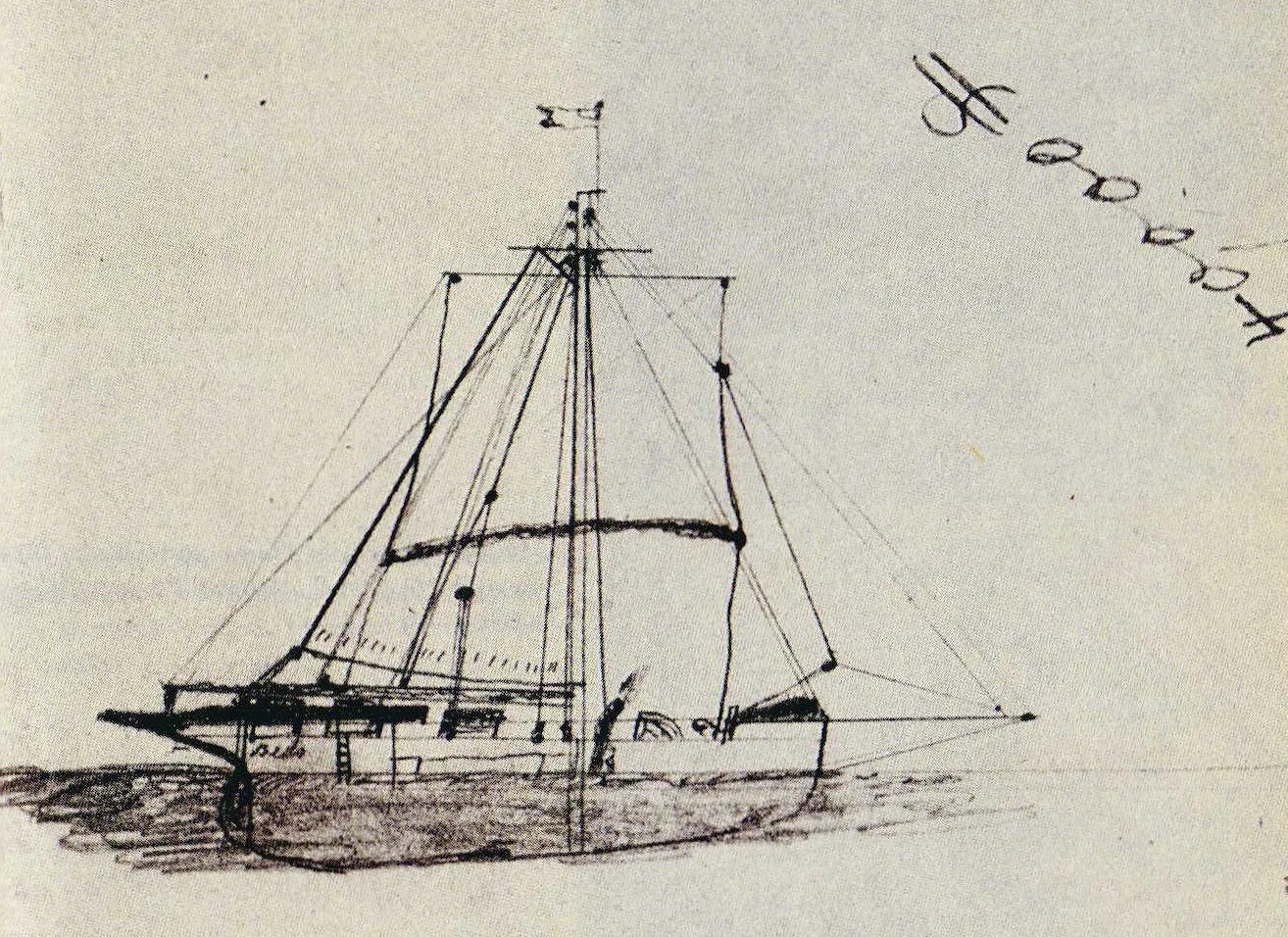
It’s the story of a sea voyage in 1884. A rich Australian bought a yacht in England. He hired a captain to deliver it to him in Sydney. The captain hired a crew of three. They set out from England. It’s a four month journey. Off the coast of Africa, they hit a major storm. There’s a shipwreck. The four crew members escape in a lifeboat. They have very little food, very little water. They’re worried about dying of thirst and starvation. At the time, it was a fairly common thing when there was a shipwreck to kill and eat someone. You’re supposed to draw lots. They didn’t do that this time. The captain just decided that the cabin boy was the sickest and the youngest. So they kill the cabin boy and eat him. Then they’re rescued and brought back to England. They tell everyone about what they did because they thought it was perfectly fine. No one had ever been prosecuted for it in British history. This is when that all changed. They were arrested and, much to their shock, put on trial for murder.
Let’s leave it at that to avoid spoilers. How did you learn about this story?
In my first year of law school, there was a ‘come as your favorite case or legal doctrine’ party for Halloween. My roommate—who is now a federal judge in New York—dressed up as the cannibal captain. He went to the supermarket and bought chicken parts and spattered them with ketchup and wore them around his neck. So that was how I first heard of it.
So this is going back quite a few years, not to age you.
Yeah. I wrote five books in the interim, and then I was looking for a topic for my sixth. I was thinking back to law school, and what were some interesting cases, and I thought of the Halloween party. And then when I looked into it, I realized that this is not only a sea adventure and a cannibalism story, but a human rights story.
What sort of primary sources exist and where did you find them?
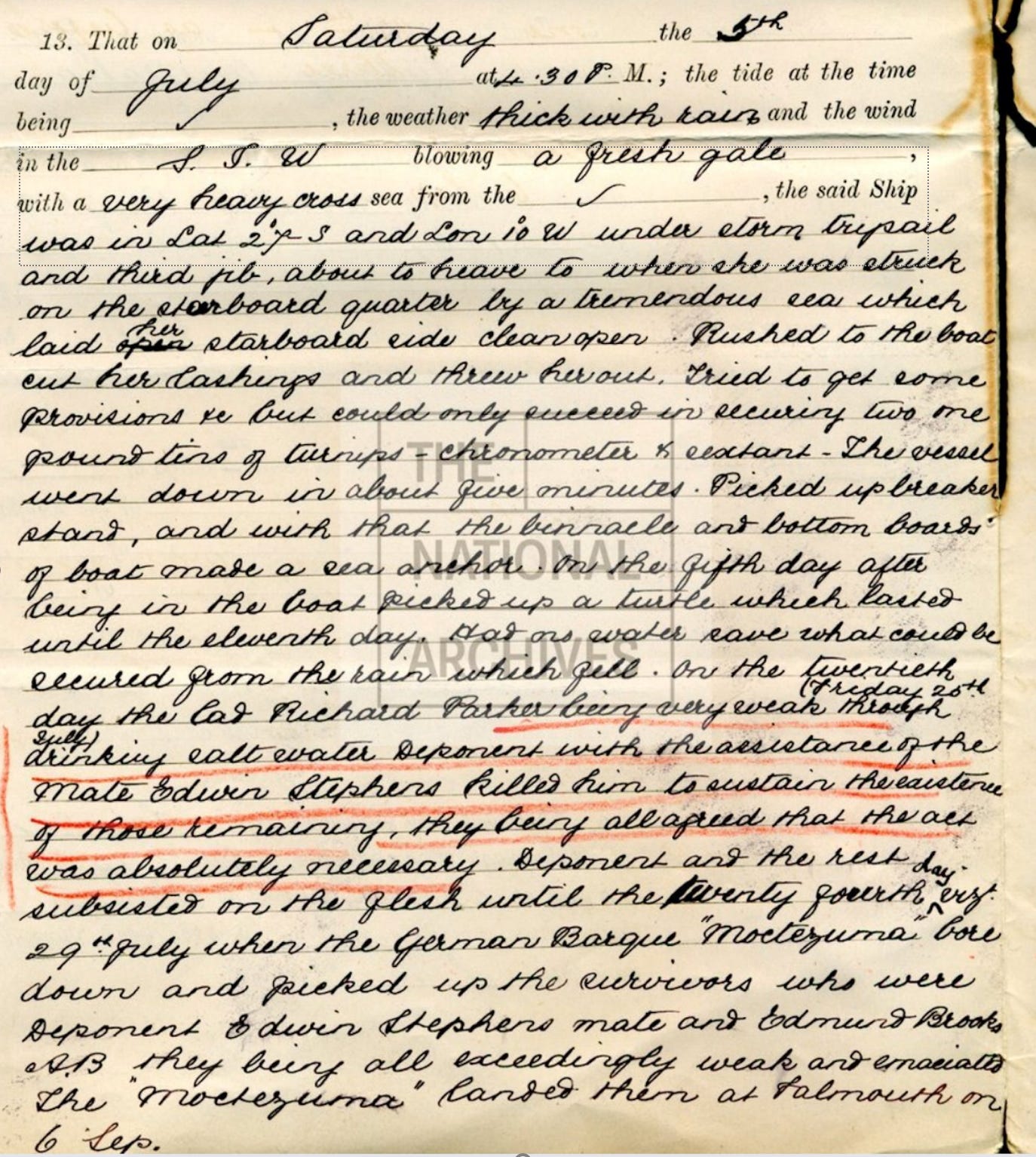
A lot of them are in the National Archives in London. It’s really a very pleasant place to study. In order to get into the spirit of the story, I stayed in a hostel called Clink78, which operates out of a jail that was part of the courthouse that Charles Dickens used to work in. You could actually stay in a prison cell. So I did that. I stayed in the jail cell. It gave me some empathy for my characters, who ended up in jail very quickly themselves. Anyway, at the National Archives, they actually have the forms that were filled out when the cannibals returned to England and described what had happened. They also have an account the captain wrote on the long journey back after they were rescued by a German ship. The trial transcripts are there too.
This is all in one single collection?
Yeah. But I also went to the Bodleian Library at Oxford. One of the main characters in my book is a guy named William Harcourt, who was the Home Secretary when all this was going on, the top justice official in England. He was the one who decided that they should prosecute the cannibals. So his papers are really important. My initial reaction after finally getting them was like, oh my God, this handwriting is almost illegible. I did use them to the best of my ability. But what also helped is that he had a son, Lewis Harcourt, who was like, twenty-one years old at the time, but was his chief of staff, his advisor. And Lewis kept journals throughout all this time, and his journals are at the Bodleian Library as well. Fortunately Harcourt’s son had better handwriting than he did.
What was some of the best stuff you found?
Captains were required to file with the regulators a list of what food they were bringing, and what they would be providing the crew to make sure that the crew was adequately fed. There actually is a chart that was filled out before this trip with the food that would be fed to the crew, seven days a week, Monday through Friday, which days would be meat, which days would be vegetables, which kinds of meat, all that. At the bottom, there was a little asterisk and it said, substitutions may be made at the master’s discretion, the master being the captain. This was of course exactly what happened on the trip, but the kind of meat was not what they had planned.
Did you travel anywhere else in England?
I went to the town of Falmouth. That’s where the cannibals were brought after they were rescued, and that’s where they were arrested and put on trial. So I drove down there just to kind of check it all out. The customs house where they were questioned is still there and so are a few other places. The jail is no longer there, but there’s a plaque. I was able to actually walk in the steps that they did when they first returned.
I assume there was a lot of good material in the newspapers.
After the pandemic began, I couldn’t go back to London, but the New York Public Library at that point decided that they would put their entire British newspaper archive online, which was amazing. There were just so many newspaper articles. These cannibals came back and they gave a lot of interviews. A friend of mine who sort of edited the book as a favor was struck by how I could recreate, day by day, what was happening. Like, the fact that the first night that they’re in the lifeboat, a shark rams them from underneath and nearly capsizes them, and they have to fight the shark with their oars. They all talked about that in their interviews. There were also many different court hearings and proceedings, and reporters went to all of them. They described details like the lights flickering and things like that.
Also, unlike some tales of the sea, there was really a big philosophical debate over whether or not these men had done anything wrong. There were a lot of op-eds and editorials and letters to the editor, taking up both sides of that. There was one letter to the editor having to do with the name of the cabin boy, Richard Parker. Edgar Allen Poe only wrote one novel in his lifetime, and it involves shipwreck, mutiny, and cannibalism.
The Narrative of Arthur Gordon Pym.
Exactly. There is a character named Richard Parker. And there was one letter to the editor pointing out that incredible coincidence, and saying, it’s the first time that the letter writer knew of in history in which nature plagiarized from fiction.
Did you consult any experts in, like, maritime history, or even human biology?
I read a lot about that. I was very interested in, you know, how long you can survive without food and how long you can survive without water. That becomes an important part of the story, because they were driven much more by thirst than by hunger. You can actually survive a very long time without food; you cannot survive very long at all without something to drink. That informed the narrative, because the first thing they do when they slit the captain boy’s throat is, they get out the bailer and they try to capture his blood. There’s a large literature of cannibalism, which I really dove into. I have a whole chapter which is really a survey of cannibalism. I enjoyed that part of the research. It was just very interesting.
This is a more cinematic story than your past works. Are you interested in doing more books in that vein?
The overall theme of my books has really been about how government and the law can either help those at the bottom of our societal hierarchies, or hurt them. This book really had that, as well as a sense of adventure. If it was the captain they had eaten, I would not have written the book. I saw this as a book about social justice and human rights. My next book, I hope it will fit that same theme.
What a great story, in all sorts of ways.