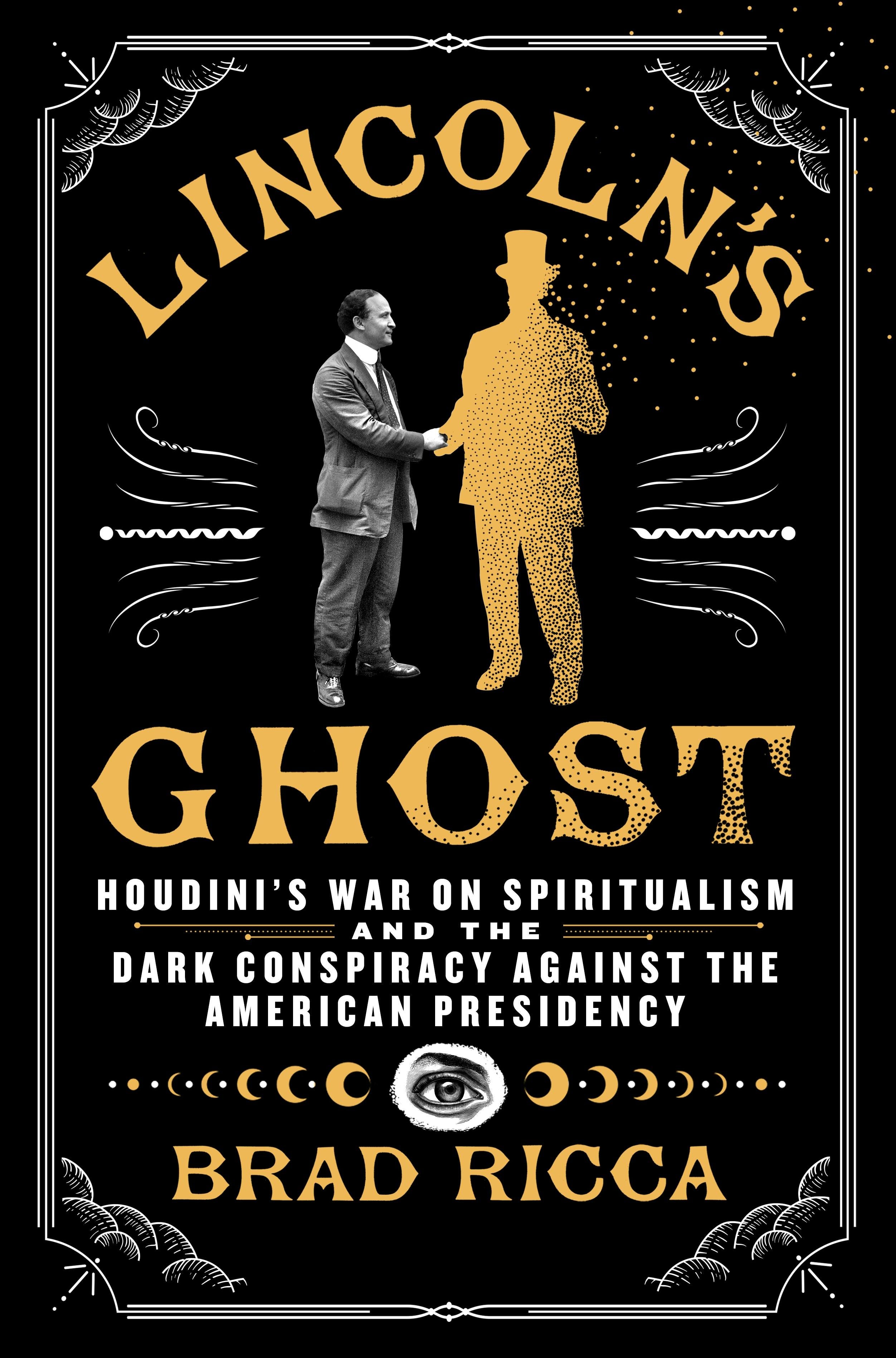
Welcome back to SOURCE NOTES, and welcome back to Brad Ricca, who joins us for his second appearance in these parts. Good timing, too: Brad’s latest hits shelves today. It’s called LINCOLN’S GHOST: Houdini’s War on Spiritualism and the Dark Conspiracy Against the American Presidency. If you run out to the bookstore right now you could maybe speed-read the whole thing by Halloween. I have a feeling you’ll want to after reading our conversation…
Tell us about LINCOLN’S GHOST.
It’s about the last days of Harry Houdini, the last year or so of his life. He kind of abandons his lifelong career of being a master magician, the greatest entertainer in the world, to fight a crusade against spiritualism. The reason I wrote the book is, I wanted to know why he did that, and why so many people were mad at him for doing it.
You collected material from a shitload of archives. Were there one or two in particular that served as your primary research vessels?
Houdini’s a real challenge because so much of the material is in private collections, and some people are really holding on tight to that stuff. That makes you mad for a few minutes, because it belongs in a museum or whatever. But then you look at it as a challenge. That said, there’s great stuff at the University of Texas at Austin. I got a lot of stuff from some Philadelphia libraries. So there are archives, they’re just kind of stretched all over the place.
Tell me more about the private archives. Did you identify collectors and try them one by one to see if they’d be willing to share stuff with you?
Well, that’s like, the best question, but you’re gonna get the worst answer: I did none of that. I mean, people have written books about trying to get Houdini stuff, like letters and artifacts, and these stories go on for years and years, and at the end, they don’t get any of it. So I kind of decided I would try coming at this as an outsider. I knew what was out there, and kind of let everything that was out there be out there.
By “out there” you really mean “in there” because this is stuff that isn’t publicly available.
Yeah. There were a couple things that I targeted, but the big thing everybody wants is the Houdini diaries. He has these diaries from his entire life that are holed away in his old lawyers’ castle. And it really is a castle. But then, parts of the diaries have been made public and they’re not great. They’re just like, really surface level things, like where he had a show, what the weather was like. There’s no interior light. So they’ve taken on this Holy Grail status. But when I saw the ones I could see, it didn’t seem like they were worth a kind of ten-year plan. What it opened up for me is that I realized he was one of those witnesses who wasn’t gonna give you anything. He was always on. He was a showman. So he was always trying to work a trick or do something to kind of sell himself or his act. And very rarely did you get a sense of the private Houdini. Luckily, there are bunch of love letters at the University of Texas that I got, and those really opened the door to, who was this really strange guy?
You got access to some of his scrapbooks too.
Yeah. He had many scrapbooks. I think the scrapbooks to me are more enlightening than the diaries, because they show kind of his mindset about what he thought was important. He had one scrapbook filled with, like, the worst possible things humanity could ever do, and he attributed a lot of it to spiritualism, leading people to murder, to suicide, you name it.
Where does one find these scrapbooks?
There are a lot in the hands of the collectors. But some libraries have them. I found one in Philadelphia, and Texas has some that are really great. They were willing to scan and look through them for me.

Did you have any interactions with collectors that went south?
Again, I kind of made the decision that there’s, like, the Houdini world and that I wasn’t gonna try to be in that space. I did put things in this book for the hardcore Houdini fans. But I knew I was writing to a general audience. I mean, will I have some negative interactions when the book comes out? Almost certainly. And part of that is, I deal with something in the book that I knew that a lot of them weren’t going to like. I’ve met some terrific Houdini scholars, but a lot of them have a vision of him as this really romanticized, almost super-heroic figure. We’ll see what they think.
I was wondering it there are actual Houdini scholars out there.
There’s a few. But it’s more like this great community of fan scholars, and the fan scholars know more than the real scholars. There are plenty of academics who have written great books on Houdini. But you go to these fans and they just know a ton. They have websites and they have books that they self-publish. The best website, which was so helpful to me, was Wild About Harry. It has like a new Houdini fact every day.
What was the best firsthand material you worked with?
A lot of the letters were really helpful. There were a lot of stories that had never been told before of people who worked for him. He had this whole group of people he called the Secret Service. One of the reasons I wrote this book is, I read this factoid that his role model was Abraham Lincoln. And I said to myself, that seems really weird for a magician. And so he kind of sets himself up as this, like, president of American magic. He’s literally the president of the Society of Magicians, and he has this group of agents he calls the Secret Service that go and bust all these fake mediums. So I was able to find a lot of their stories and tell them for the first time. A lot of them were women, which is really interesting. One is a reporter, and she goes undercover at a spiritualist camp. She’s telling her readers all these stories like, the spiritualists say she’s gonna meet the man of her dreams, she’s gonna have six kids or whatever. And at the same time, she’s in real danger, physical danger, once they find out she’s a reporter.
What was her name?
Virginia Swain. Her writing starts out in one paper and it’s so good that it immediately gets syndicated. It’s so funny. She has such a good voice. She’s just like, destroying these people. But at the same time, when she goes to leave, they attack her car and start screaming, “Lynch her!”

Did you draw on a lot of newspapers overall?
Newspapers are always a good source, especially in the twenties, when there’s a lot of newspapers and Houdini is such a big topic. It’s interesting to see how different newspapers would cover the same event. I’m also a little wary of 1920s newspapers, but if you have enough coverage, you can kind of get at something in the middle.
I also find that, for things like trials, or the Houdini congressional hearings, newspapers are how you know, like, the witness shifted in his chair at this particular moment or whatever.
Totally.
Did you have any breakthroughs? New information that hadn’t previously seen the light of day?
There are two big ones. Houdini’s enemies in spiritualism, there’s a group called the National Spiritualists Association, and they’re very serious about their work. It’s kind of like a religion, but not a religion. They have a headquarters, they have a huge membership, they’re hugely popular after so much death in World War I and the 1918 flu. I was able to find out who was behind them, and it turns out there’s another group behind them. This is a book about ghosts. A lot of it’s goofy, but some of it’s scary. The group behind the National Spiritualists Association is as scary as it gets, and that really surprised me. It kind of just raised the stakes of what was, you know, kind of a fun magic-show book. And then at the end, there’s kind of a big thing that happens that I totally didn’t plan for, and I don’t wanna spoil it, so, sorry!
I don’t want you to spoil it because I’m still in the middle of the book.
I’ll just say it’s a very, very personal secret about someone in the book.
Edge of my seat. Are you already working on something new or is it back to the old drawing board?
I am working on something. I can’t say what it is. No ghosts, but more evil.