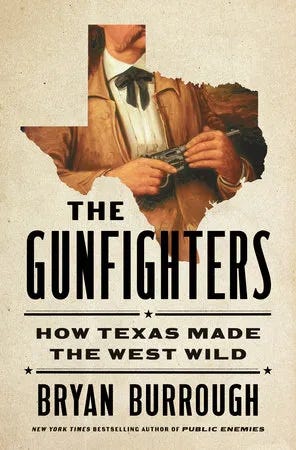
Welcome back to SOURCE NOTES. Bryan Burrough needs no introduction, but I’ll give one anyway: Vanity Fair legend. Bestselling author of books like BARBARIANS AT THE GATE, DAYS OF RAGE, and FORGET THE ALAMO. Fellow storyteller of the Hall-Mills murders (and gracious blurber of BLOOD & INK). And longtime aficionado of the Wild West, which is the subject of our conversation on his new book, THE GUNFIGHTERS…
What’s it about?
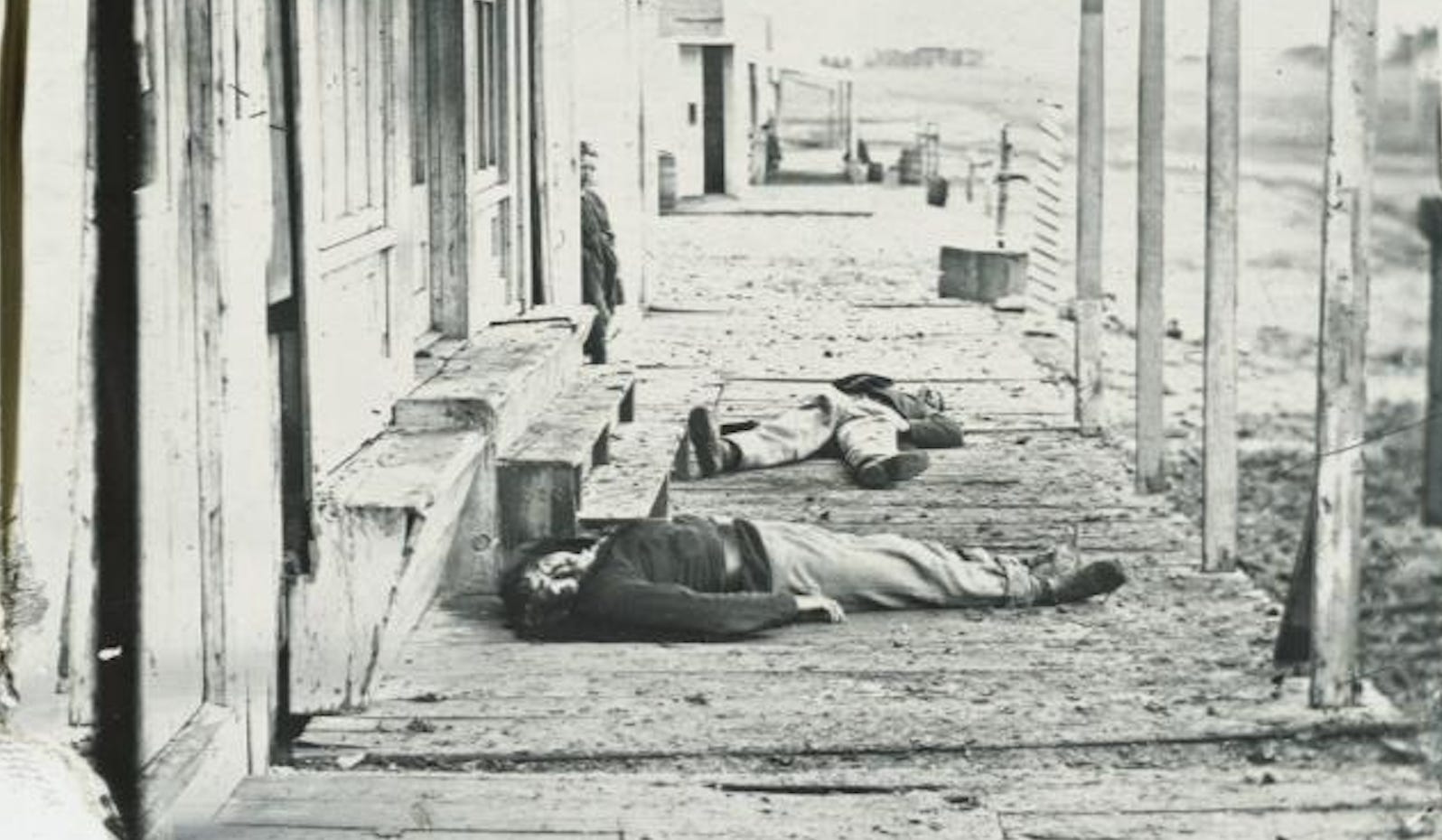
The Old West gunfighters who have fascinated me since childhood. I got my first gunfighter book when I was eleven. What I tried to do—and I think I pulled it off—is write a narrative history of the gunfighter era from 1865 to 1901, about a bunch of different people who had nothing to do with each other, but who all inhabited the same kind of cultural and technological milieu, which is that they all became famous for shooting people.
Where did you hit the ground running with your research?
Well, everybody starts with the original gunfighter books. There’s Time-Life’s collection of leather bound, beautifully colored Old West books put out in the seventies. That’s what I had on my shelf as a boy. The other one was a book by a guy named Joseph Rosa from 1969 called THE GUNFIGHTER: MAN OR MYTH? It addressed this kind of emerging archetype that was showing up in TV and movies.
You write in the acknowledgements that THE GUNFIGHTERS was a more solitary endeavor that you previous books. Is that just because this one didn’t involve any reporting or navigating library archives?
I spent years in the National Archives for DAYS OF RAGE and PUBLIC ENEMIES. This book just wasn’t the same type of thing. Everything that mattered had already been bound, and very little new stuff has come out in the last twenty or twenty five years. As a result, it was pretty clear early on that I was just going to buy every book that’s ever been written about, let’s say, forty of these guys and everything that’s adjacent, like gambling and western life. The research was buying, reading, and then thinking about books.
Did you miss the archival research and reporting or were you having plenty of fun just burying your nose in books?
When I started this, I was in my late fifties and I’d just begun a new relationship with a woman who I’m now married to. And then there was the pandemic. So this really fit the life I wanted at the time.
Tell me about the books. How many are we talking?
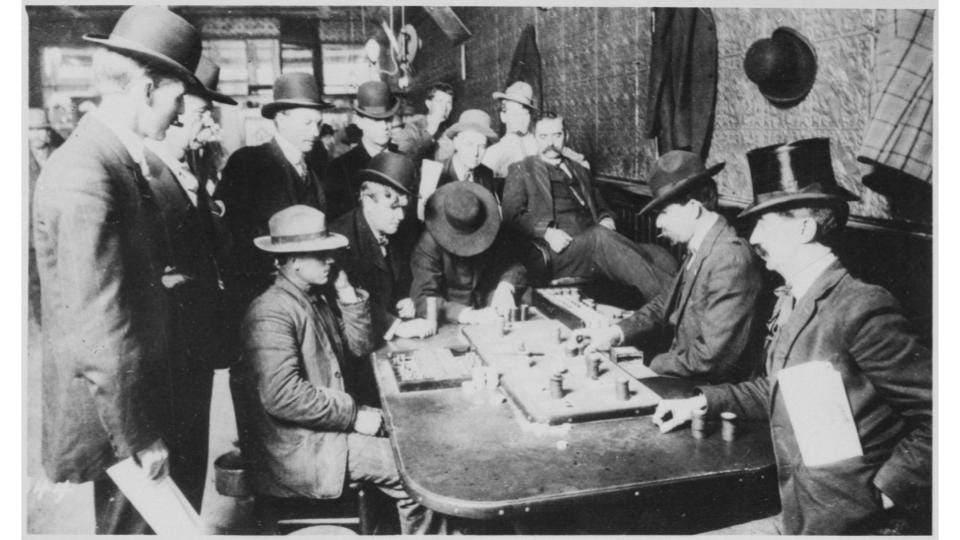
I would say, looking at the wall, it’s probably more than three hundred books. There’s a Big Five of gunfighters, so that’s Jesse James, Billy the Kid, Wyatt Earp, Wild Bill Hickok, and John Wesley Hardin. That means I had to get every book that’s ever been written about them, or even near them. I’m writing a book that gives you a chapter on people like Jesse James or Wyatt Earp, about whom there are eight-hundred-page books, so I’ve gotta have everything. The challenge is, I cannot write a chapter of a book about people this well known unless, at the end, people who really know about this stuff go, hmmm, that’s an interesting new take. I’ve gotta do that on every single fucking guy. So that’s the first thing. Then I’ve got this theme about the importance of the Texas open range cattle business. That means I’ve gotta have every book ever written on cattle and cowboys. And then you start to get into the secondary and the tertiary gunfighters—guys who killed six people in New Mexico in 1879 that you’ve never heard of.
You didn’t read every book cover to cover did you?
I did not. Most of them I buy for a reason, like for an anecdote or a theme. I hit the index hard and then scan it for the stuff I want. Of those, let’s say, three hundred fifty or so books, I probably read fifteen percent cover to cover. What you’re doing is building a reference library.
Any books that were particularly difficult to get your hands on?
I had to go to Abe Books for maybe two or three. I mean, this is not obscure British literature. What’s obscure here would be a memoir by some woman who knew Billy the Kid in 1881. For the most part everything has been reclaimed and republished, often by tiny presses. But Amazon has just about everything in the world. There was nothing especially difficult about gathering the research here. It was more like, okay, it’s Tuesday, and I just ordered eight more books.
Tell me about some places you visited in order to bring them to life in the narrative.
Billy the Kid’s story has two major chapters. The second chapter is about him as a cattle thief slash outlaw. The first chapter, the one that establishes his notoriety as a gunman in New Mexico, involves a feud over power in Lincoln, New Mexico. The town is extraordinarily well preserved—like, perfect. Most of the original buildings are there. It’s a small, very intimate place set between two hills. I would contrast that with Tombstone, which I found depressing. It has kind of an RV and biker vibe. Lots of bad billboards. Dodge City has pretty much moved on. Other than a couple of nice museums, it’s just another Kansas town of sixty thousand people or whatever it is these days. The most evocative places to go in most cases are the graves, and everybody’s got a grave. I did not go to all of ‘em, but I went to most of ‘em.
So you did a road trip?
All around Texas, and then from El Paso to Tombstone, and then to all the Arizona sites, and then back to all the New Mexico sites.
How long did it take?
I did it in a month. I only got two speeding tickets. You get to go and hang out doing stuff you’ve really wanted to do since you were eleven, and you’re getting paid to tell other people about it. That’s about as good as it gets. I've had difficult books. This was not a difficult book. It was a joy.
What about Old West experts or academics that you relied on?
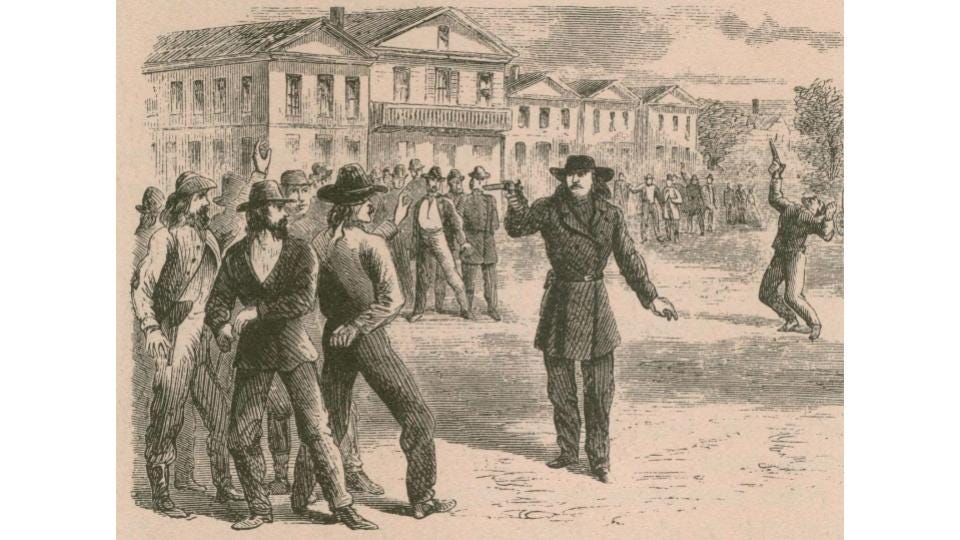
The guy that kind of dominates gunfighter and Old West narrative is a guy named John Boessenecker. He’s been in the field for forty years. I leaned on John anytime I had a judgment call or learned something new and wanted to gauge if it’s credible. I also identified experts on individual gunfighters. You don’t want anyone in the field to be surprised when your book comes out. You want ‘em to know that you took this seriously and respect their work.
How many of those guys are out there?
Maybe about a dozen. There aren’t as many as there used to be. And very few are younger than me.
Did you find any good material in old newspapers from the period?
I didn’t find them particularly useful. Most of the good stuff is in the biographies already. It was rare to find a newspaper item that hadn’t already been in the literature. And this literature is one hundred fifty years old.
But the newspapers, they were covering these guys at the time?
The Gunfight at the O.K. Corral—that made, I wanna say, page three of the Philadelphia Inquirer. So these things were known, but they became much bigger later on. The great glorification and discovery of the gunfighter really didn’t start until the 20th Century, and especially in the fifties.
Now that you’ve done FORGET THE ALAMO and THE GUNFIGHTERS, do you want to stick with the Old West for your next project?
I thought I might. I’ve now done three Texas books. For a while, I thought I was gonna write a new narrative history of Texas. And I ultimately decided I just didn’t care enough. After THE GUNFIGHTERS, my editor came back and said, what are you gonna do next? And I said, I haven’t even thought about it. And he said: pirates. We’re talking the Golden Age of Piracy, between 1650 and 1725. I’ve been reading about pirates since I got my first Blackbeard book when I was eleven. I thought about it, and my wife asked me, well, what would be fun? What would get you excited? And I’m like, I’m gonna do fucking pirates. So that’s what I’m working on.