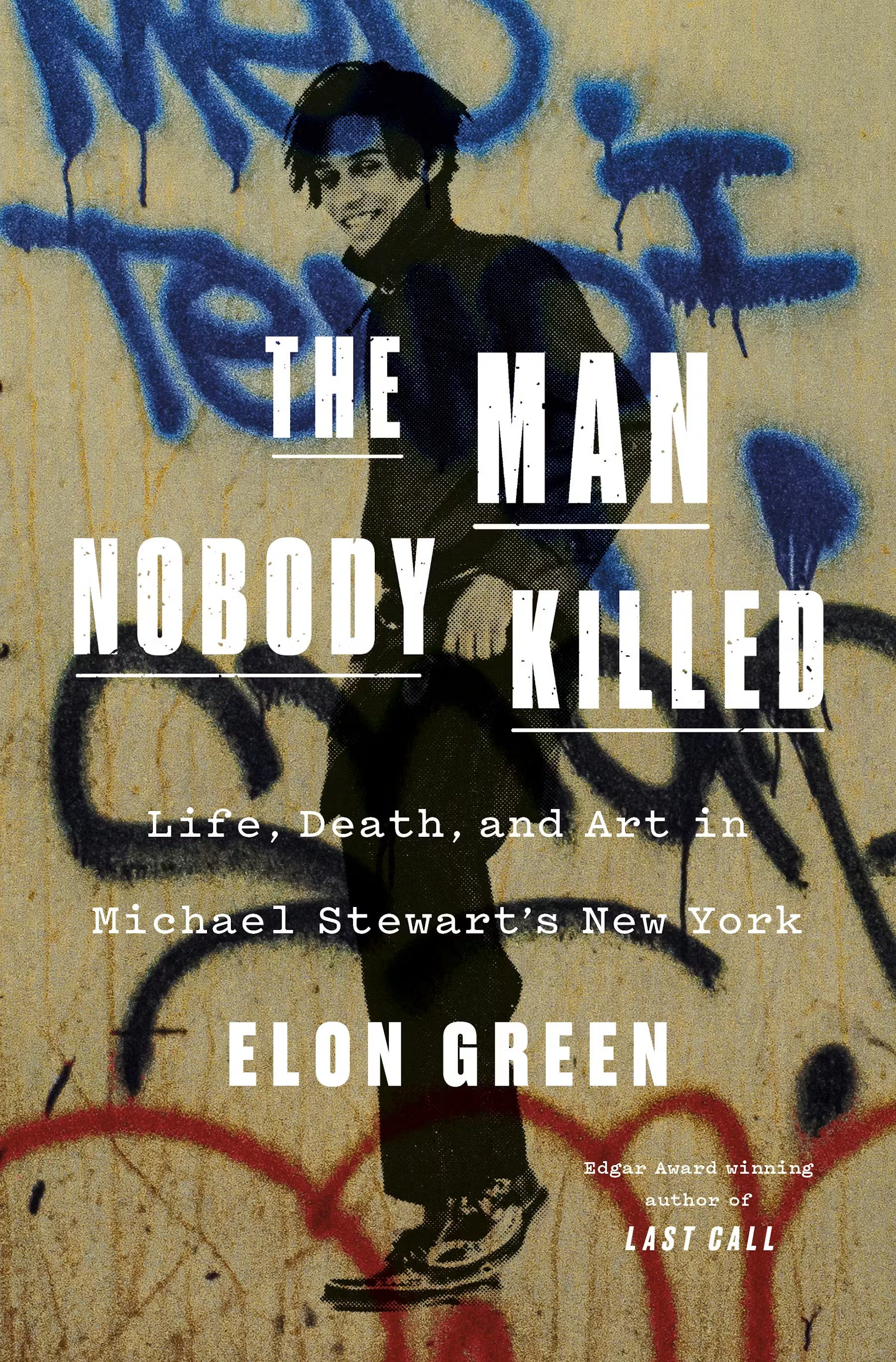
Hello from Spring Break vacation in Florida. And welcome back to SOURCE NOTES. And welcome, new subscribers. Edgar Award-winner Elon Green’s second book, THE MAN NOBODY KILLED: Life, Death, and Art in Michael Stewart’s New York, just landed in paperback. It’s a page-turner in which New York City police brutality meets early eighties tabloid journalism meets the Pyramid Club-era East Village scene. Come for the propulsive racial justice narrative, stay for the superstar cameos. Let’s go.
Let’s hear about THE MAN NOBODY KILLED.
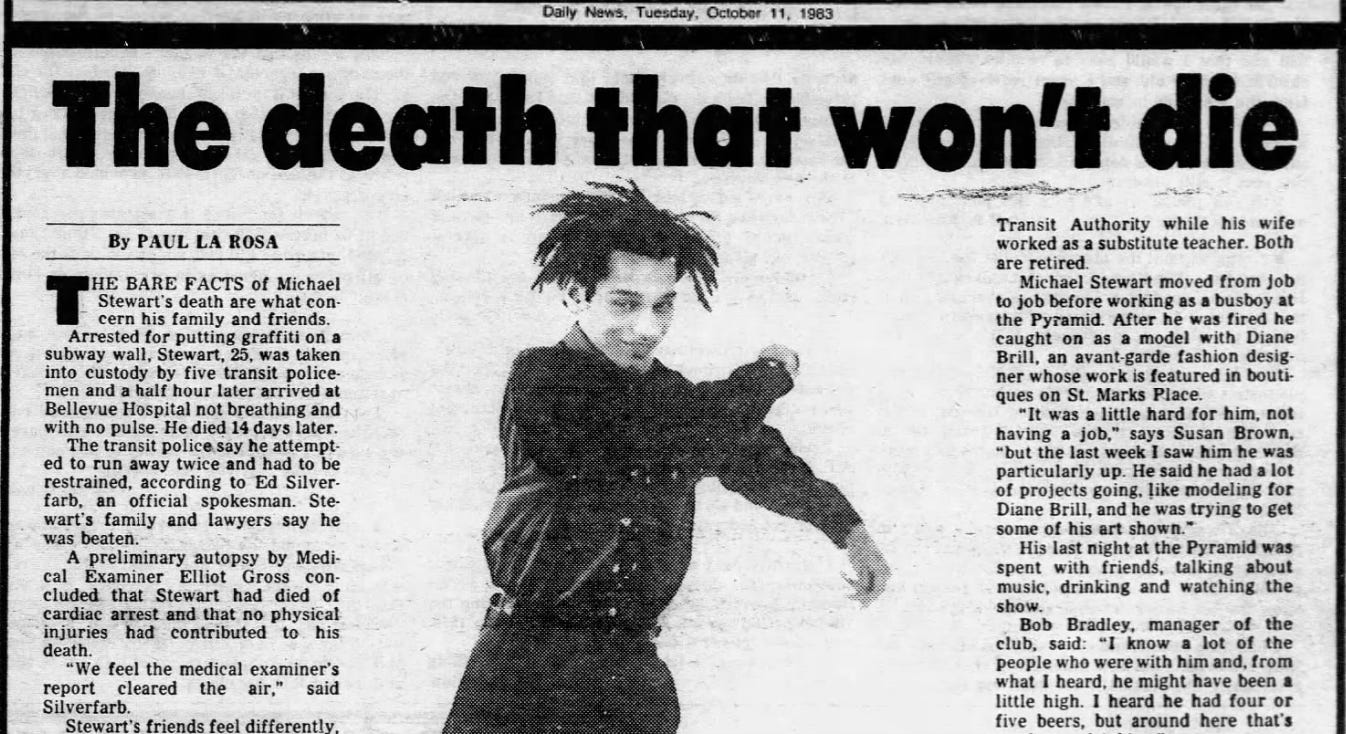
The book is about what, at the time, 1983, would become the most notorious police brutality case in New York City history, up until that point. The victim, Michael Stewart, was tall, handsome, very gentle and unarmed, thoroughly nonviolent, and he was beaten into a coma by transit police. And one of the reasons the case became such a cause célèbre was that he was part of the East Village artistic community, and so he had crossed paths with people like Keith Haring and Madonna, whose first music video he appeared in. And his girlfriend was also dating Jean-Michel Basquiat. A lot of people who, at the time, were only starting to get big in New York but would eventually be big globally, would have known him, and they responded to his death.
Most of stories in this column are quite a bit older. You on the other hand had lots of living sources to work with. What’s the ratio of reporting to archival research?
Most of my time was spent interviewing people, even though that ends up being a smaller part of what ends up in the book, because there was so much archival material. This was not just a heavily covered story, but also a heavily investigated story because of the systemic issues that arose from it. So, for example, the MTA, which was the governing body of the New York City Transit Police, did an investigation. The office of the chief medical examiner was investigated. There were, I think, at one point, like, five investigations having to do with this case. All of those investigations are incredible resources, and they were all sitting in the Municipal Library down on Chambers Street. But I ended up interviewing one hundred twenty-five people: witnesses, lawyers on both sides of the case, the judge, members of the grand jury, the criminal jury. I interviewed six or seven people just to write about the Pyramid Club. I interviewed the Bellevue Hospital policeman who was by the door when Michael was wheeled in on a stretcher. I tried to get to everybody who conceivably could have been in the room for anything I wrote about.
The investigative documents were all at the Municipal Archives?
Well, some. And then there were some in people’s attics, some that I was given by the defense attorney. A lot of this stuff ends up in in different places. But certainly some of the key documents were in the Municipal Library.
What other materials did you draw on?
The papers of Ed Koch and Robert Wagner. Columbia scanned stuff for me from Robert Morgenthau’s calendar. I went to the New School archives because I wanted to see if there was anything in the Parsons newspaper about the case. But one of the things that ended up being helpful was, I was writing a lot about the freshman dorm, and they gave me the student handbook from that year, which described precisely which students were allowed to live in that dorm. And it helped me flesh out a portrait of 31 Union Square West. The Princeton library was helpful because, in the epilogue, I write about a Toni Morrison play that was partially based on the Stewart case. And I spent a lot of time at the Keith Haring Foundation archive. They’re an extraordinary institution, not just because of the volume of what they’ve archived, but because of how well they know their material. So when I approached them and said, you know, Keith writes about the Stewart case in his diary, the published diary, but is there other material that didn’t make it into a published book? And one of the key things that they gave me was a transcription of a recording that had been made— and since lost—of a conversation between Keith Haring and the art critic Rene Ricard where they keep going back to Michael’s case. It’s the most crazy sort of fly-on-the wall transcript, because nothing about it was ever supposed to see the light of day.
That’s an exciting find.
When you read nonfiction—and you know this because you do this work—you can sort of intuitively figure out, okay, this came from a court transcript, or a primary source interview, or whatever. But this was one of those documents where I thought, why would anyone know where this came from?
Right. Where you’re putting something out into the world that otherwise would’ve just sat there collecting dust.
The other scene like that in the book is a scene that takes place in a grand jury bathroom. Three are three people in the scene and it’s verbatim. And the reason I have that is because it was in these grand jury notes. And because it was a meeting, it had to be recorded by a stenographer, and it takes place in the bathroom of the grand jury. That was one of those things where, as soon as I got that document, I was just like, so excited to write it.
I wanna hear about the Franck Goldberg video.
The book would not have been possible without Franck giving me the rough footage of what he had shot. He had edited together a short documentary that was screened at the Guggenheim. But he gave me everything, and because he was talking to people in the immediate aftermath of Michael’s beating, even before Michael died—including Madonna and people like that, but also just like, regular employees at the Pyramid, or at the protest in Union Square—I had this fly-on-the-wall footage.
I have this scene of a press conference that the medical examiner gave in the in the hours after Michael died. And the reason this footage is valuable is, Franck was shooting before the press conference starts, and he shoots one of the transit detectives talking to a reporter, and he gets footage of the detective lying to this reporter.
Good segue to the newspaper coverage.
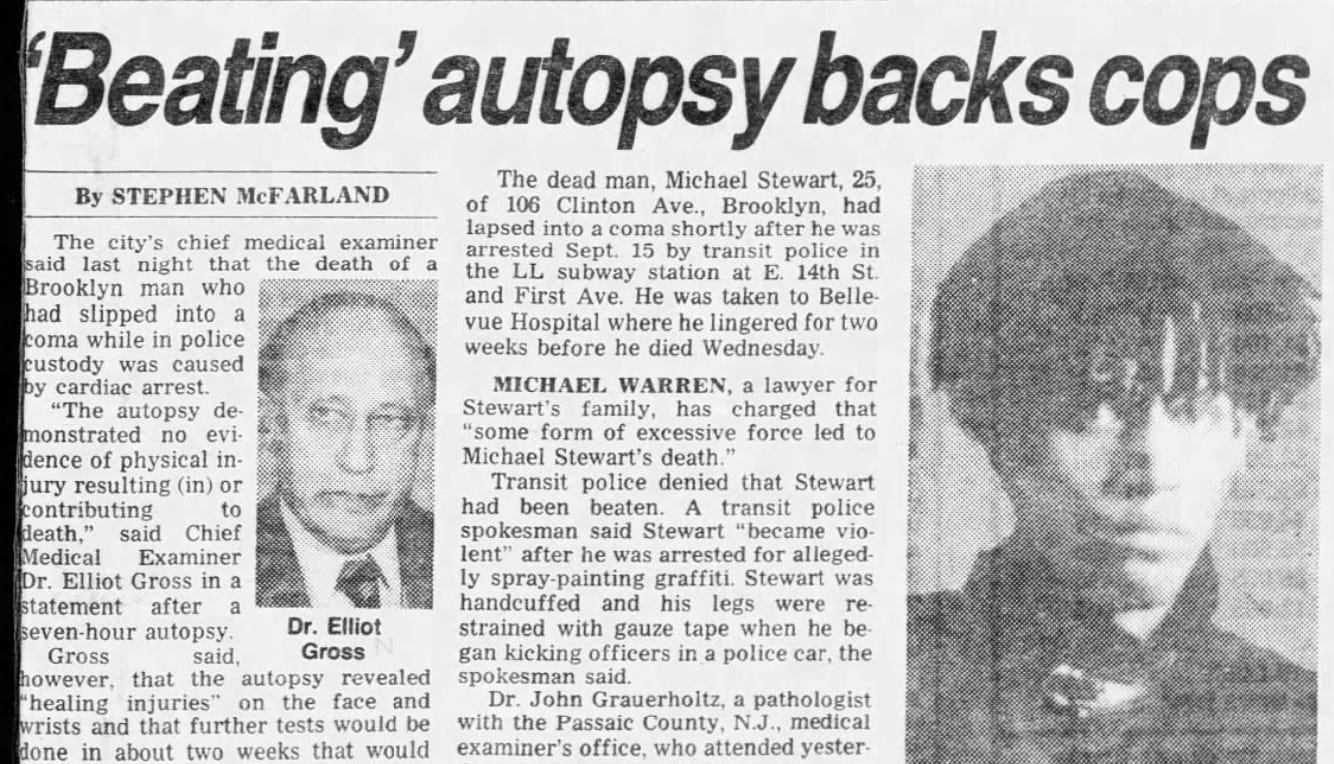
The Daily News and Newsday were great. Jimmy Breslin’s coverage, particularly of the trial, was extraordinary. He was showing up to days of testimony when nobody else was at the trial. The coverage in The New York Times is stellar, and that’s because the correspondent was a young reporter named Isabel Wilkerson. Leonard Levitt’s coverage for Newsday was unbelievably good. He did, I think, the only interview in that period with Michael Stewart’s mother, and there were so many key biographical details in that interview. One of the few sort of alternative publications that covered the story—because The Village Voice did not give a shit—was the East Village Eye.
Oh that’s interesting.
They had great coverage. But the first story they published had this very inflammatory detail, which was that the nurses at Bellevue could not get Michael’s handcuffs off, and that the handcuffs had to be sawed off. I had that in the book until very late into the process. This was an article written in late 1983, and even though I couldn’t find that detail anywhere else, I felt confident in it. But then I got put in touch with the guy I mentioned earlier, the Bellevue policeman, who the article had identified as the guy who sawed off the handcuffs. And I mentioned that to him and he said, no, I just jiggled the keys.
Sawing off handcuffs is the kind of thing you would remember.
I thought, well, shit. That detail’s out the window.
Can you say what you’re working on next?
I’d love to say what I’m working on, except I haven’t found it. I mean, I love writing about New York City. Ideally, I’d love to keep writing about New York City, because the more you write about something, the better you get to know it. The beauty of New York is that you can go, like, six blocks to the west and five years into the past, and it’s an entirely different city.